Monday, 12 October 2015

Into the Maelstrom: First Taste of Maelstrom Missions

Howdy Wargamers and Hobbyists.

Another article for you which is guesting on the Creative Twilight blog, my initial 'hot out of the hot zone' impressions and thoughts about my first game using the Maelstrom Missions and Objective Cards.

I hope it makes for interesting reading. Here is 'Into the Maelstrom'.


Thanks for reading.

Wednesday, 23 September 2015

Sprue Cutters Union - Heroic Scale!

Greetings Wargamers and Hobbyists, and welcome to September's Sprue Cutters Union post.


This month we have been asked for our thoughts on a subject that certainly means something rather different for us miniature wargamers than it will for my scale model building compatriots:

What is your favourite scale to work in and why?

I am working on the assumption that when a scale model builder is considering this question, it will nudge them to consider which of the various standardised kit scales they prefer to build, and I also suspect that this relates generally to vehicle kits of one sort or another, whether they are WWII armour or 21st Century fighter aircraft and super advanced naval vessels. I imagine there will be questions raised about the relative complications of working at various scales, or perhaps the availability of favoured kits or lack thereof in certain scales.

As a wargamer, for me this means the same, but at the same time something different, because a different scale of model means more than just the size of the finished build, and the intricacies of the project depending on the level of detail involved. To a wargamer, a different scale often means an entirely different game system, if not also a different genre as well.

So, when wargaming, what does it mean to model an army at a particular scale? Well in wargaming circles there a plethora of game systems to choose from, covering every period in history and even the future, science fiction and fantasy, steam punk and alternate realities. And that barely scratches the surface.

So why would different games use different sized miniatures in the first place? Typically it affects one thing in particular: The size of the conflict. If you want to fight a small skirmish, perhaps between a half dozen or so elite models, then collecting, assembling and painting 54mm models or larger is a fulfilling project. If you want to fight out the Battle of Waterloo at the same scale however, with one model representing one soldier, then you would probably need a battlefield the size of a football pitch to play out the engagement at 54mm.


From the Waterloo Diorama Facebook Page - #makesmewannaplay

Battle size. That's the name of the game then. If you want to be able to play a game with less than 10 models per side, you can be happy working at anywhere from 28mm up to 90mm. If you want to play out your average battle game at around 50-100 models per side, then 25-28mm is about right, and seems to be the most commonly occurring and popular scale. If you want to be able to play out truly epoch shattering battles, then the size to go for if you a). want to be able to conclude the game in this lifetime and b). don't want to have to barricade yourself inside the local town hall to have a big enough space to play it out is probably 6mm or less. I only found out this year that there is such a thing as 2mm model soldiers! 

Our game of choice affects both which scale we are likely to be working at, and also how likely we are to come into contact with other scales. If you are a hardcore 40K player for example, playing at 28mm 'Heroic' scale, then all your models will be at that scale, whether they are infantry models, tanks or mighty bipedal war engines and aircraft, however if the game setting is as much a draw to you as the gaming, and you want to be able to play out other types of game set in the Grim Darkness of the Far Future, then you could be drawn into playing Epic - a large scale battle game with 6mm models - for really big battles, or Battlefleet Gothic for the battles in space before the land battles even begin.

A game of Battlefleet Gothic, in which Imperial Torpedoes are 200ft long!

A very old shot of the precursor to Epic - where entire companies of tanks and infantry engage in battle

Fellow modellers, we have our choices, our options, our world of hobby goodness to cherry pick what we like from and bend the resin, metal and plastic to our will. But which scale do I prefer? Well the games I play most are Warhammer 40,000 and Age of Sigmar (until recently Warhammer: The game of Fantasy Battles), and the vast bulk of my collection is at 28mm Heroic Scale. 

This is a malleable scale that offers great modelling and painting opportunities, and isn't as daunting as a larger model may perhaps be. It is also a very popular scale in the industry, which means that even if we play predominantly one game, we can sometimes find suitable models for that game from outside the system. For example, it is becoming more and more common to find models from Mantic Games or Mierce Miniatures in Fantasy armies, or Kromlech and Wargamma models in 40K armies. 

But...the problem with models collected for armies is that there tends to be rather a lot of them, and sometimes, it is a welcome change to be able to work on something not only from a different genre of game, but also an entirely different scale. This is part of the reason I have recently been adding to my collection of Battlefleet Gothic ships, and have just started the task of refurbishing my entire collection of Man O' War ships. 

Models such as Battlefleet Gothic and Man O' War ships, and miniatures for games like Epic are of course much smaller and the level of detail is, well, not necessarily less fine, but certainly less 'specific', and this means that they are in some ways easier to paint. BFG ships for example can easily be made table-ready with a spray base coat, followed by some dry-brushing to bring out the detail, and finished with some carefully applied spot colours to 'bring out their eyes', and all in double quick time, and this is a far cry from a large unit of 28mm models that all require upwards of five or six colours, details like weapons, armour, pouches and belts, teeth and eyes etc. 

This doesn't mean that you can't spend far more time on the smaller scale miniatures as well, and produce some mind boggling results on a much smaller miniature, but this isn't always necessary, as the desired effect is the look of the model, army, fleet or warmachine on the tabletop, in amongst other miniatures, scenery and the accoutrements of a typical wargame. If you are a gaming hobbyist it is more about the overall impact of the game, and less about the individual model.

The answer to the question then, of which scale of miniature I prefer to work on, can only be this. It depends on which call to war I hear blowing on the wind on any given day, and I will prepare my chosen weapons of war accordingly.


As always my friends, thanks for reading.


Thursday, 3 September 2015

What do we want?

Welcome wargamers and hobbyists to another post guesting on Creative Twilight.

After reading so much recently from gamers wanting to be provided with some guidance by Games Workshop for structuring their games of Age of Sigmar, I decided to give my thoughts about what I feel is something of s crossroads in our hobby.

I hope this sparks some creativity and reassessment of where we are going in the hobby. Your thoughts on this topic are welcome.


Thanks for reading.

Thursday, 27 August 2015

Sprue Cutters Union - Invisible Detail

Greetings Wargamers and Hobbyists, and welcome to the workshop. I am here this time to answer the latest question to be posed to the illustrious members of the Sprue Cutters Union, and it is one that in my opinion pits the desire to achieve the highest level of attention to detail that we are capable of against the practicalities of time constraint and the preservation of our very sanity...


Do you bother with details that will not be seen in the finished product or do you pour your heart and soul into each nook and cranny of the build?

I guess this is a question that can be approached from a number of angles. Is the piece you are working on a gaming miniature, a display miniature, a competition entry or even a commission paint job for a customer? All of these questions will impact both the degree of effort you can or are prepared to put into a paint job on a miniature. A competition entry may end up being the greatest piece of art you have ever produced, and a 'basic standard' commission piece may be a 'quick and easy' entry level job at the lower end of your pricing scale.


The vast majority of the models I build and paint are gaming miniatures. In practice this means that they are primarily used to fight battles, they are handled and moved around a lot, and they often sit among a group of similar models as part of a larger unit. This also means that most of the miniatures I paint are rarely going to be looked at from less than a couple of feet away, and are even less likely to be turned upside down to see if their nether regions have seen the caress of a brush.


Most gamers are too intent on the game they are trying to avoid losing, rather than the groups of similarly painted miniatures that compose the enemy army to be overly concerned with a really close up inspection of the paint job, and when they are taken with the appearance of a given model, it will tend to be a model which is a focus point of the collection, like a character, a monster or a vehicle. These are what gamers refer to as 'Centrepiece Models'.


Typically only a smaller portion of a gamer's collection is made up of what we call 'centrepiece models', which are often large and impressive kits, and as such draw more attention than the models around them. This therefore tends to mean that they are scrutinised more closely by others. It also tends to mean that, as we know they are a focal point of the army, and this is part of the reason we bought them in the first place, that we are often likely to spend more time on painting them than we would the faceless rank and file of the army.


There are of course those who couldn't do an 'average' paint job on a model if they tried, those who paint every single model in their collection as if it were the last model they would ever paint, the model that they would be judged by forevermore. But we won't talk about those people. For myself, and I imagine for the majority of other gaming hobbyists, the amount of time and effort I put into painting a model, and the degree to which I lavish attention on the bits I know will rarely - if ever - be seen by another person, depends mainly on what the model is and it's role in my collection.


My character models and elite units are going to have much more time spent on them, including the deep recesses of cloaks, the inner folds of clothing and armour, and saddles which will be hidden when the model is assembled, than a model in the centre of the third rank of a horde of Skeleton Warriors, quite simply because with his fellows obscuring the view to him from all angles, and the fact that when not marching to war he spends most of his time stowed in a foam lined carry case, there seems little benefit in spending 'extra' time and attention on areas of the model that never likely be seen.


Equally, the command models of that same block of Skeleton Warriors will get far more brush-time, because not only do they tend to be more impressive than their rank and file brethren, they also carry interesting accoutrements like musical instruments and unit standards rather than just weapons. They are also the last models to be removed when the unit is finally destroyed by the enemy, and they are the models that form the focal point of the front rank. They are the 'face of the unit' if you will, and the rest of the unit are pretty much just filler.


In gaming circles there are a few variations of a phrase: Bases, faces, banners and shields. These are the areas if a model that draw the most attention, and whether it is a centrepiece model or a rank and file nobody, if you get these areas painted to a reasonable standard, then shortcuts elsewhere can go unnoticed. I for example am in the process of trying to paint as many models as I can to a 'battlefield standard' before the end of the year - almost at 180 infantry models, of a target of 250 - and this doesn't mean painting sloppily (not deliberately at any rate), it means painting to a more basic standard that looks fine on the table, but that I can come back to later down the line to spend more time on things like eyes, teeth, general highlighting and other smaller details which just aren't necessary when the goal is to be able to put models on the table for games without cringing.


Part of being able to get through models quickly does however involve cutting corners where I can, and on the unit of 25 Chaos Marauders I am almost finished with for now, this might mean painting a thin layer of brown onto the backs of the shields and leaving them at that, rather than bother with the metal banding and any washes or highlights that are entirely out of sight unless looking at them from behind and beneath. When you look at them from the front, they will look fine, with no obvious bits missed.


Some people take other short cuts with gaming miniatures. If the hatches on a vehicle are going to be closed the whole time, where is the benefit in painting the inside of the passenger compartments? What is the point of painting the underside of a tank or bike if no one will ever see it?


I have heard stories about some armies people have painted to a very strict deadline for a gaming tournament, and tales of weary and bleary eyed gamers painting into the small hours by candlelight the night before an event are common. In these cases it would not surprise me at all to find that corners have been cut wherever possible in an effort to get the entire army to a presentable standard for the event, especially as painting marks are on offer and contribute to the overall winner of the tournament. Though when we hear about gamers who have painted the front of a miniature to an enviable standard, yet have left the back of the model simply base coated because they didn't expect people to see it, you have to wonder when people have bitten off more than they could chew.


For my final thoughts on this topic, I have already described as a gamer which models are going to get more attention and which models less depending on their role in the army, but I think there is also an area of overlap in some cases. When a hobbyist reaches a certain level of ability, and their painting becomes noticeably better than the results of those around them, their collection is probably going to attract an ever increasing volume of attention until, regardless of whether a model is a large centrepiece creature or an inconspicuous infantry model at the back of a reserve unit, every Tom, Dick and Harry is being looked up and down and all over for the quality of his battle attire.


When every model is lavished with a greater than average level of attention to quality and detail, every model is more likely to be scrutinised even more closely than their counterparts in less eye-catching collections, and when that happens, will the painter still feel happy that they can cut the odd corner in order to hit that tournament deadline, or will they have become a victim of their own skill and success, doomed to paint every last shield rear, undergarment and horse's tackle until their eyes fail and their hands shake after decades of painting every boggling detail, just in case someone decides to have a closer look at a model from the back of a unit just to see if the quality of painting is consistent throughout the army?


A nice problem to have some would say.


As always, thanks for reading.


Monday, 10 August 2015

First Taste of Age of Sigmar

Greetings fellow Wargamers, and welcome to my second guest article for the Creative Twilight blog. I hope to be able to help Thor expand the reader base for the site by branching out from the primarily 40K content on the blog, and this is my first step in that direction.


I've played a couple of games of Age of Sigmar now, and felt it was time to give my initial impressions of the game, and also thought it might be good to write up something nice and early after the release so that in six months time I can re-visit the state of the game and see how things have changed.


So, without further ado, I give you - First Taste of Age of Sigmar.


Sunday, 19 July 2015

40K is Epic!

Hey guys and gals, and welcome to my humble blog once more.

On and off from here on I will be contributing articles to the gaming blog 'Creative Twilight', as well as posting here, and to make sure you done miss out on those articles, I'll be linking to them from my Eternal Wargamer blog page. Topics like my Sprue Cutters Union posts will continue to appear in their entirety here, but it is nice to be able to do something collaborative alongside other gamers.

So here we are with my first post as a contributor: 40K is Epic!

I hope you enjoy it, and thanks for reading...

Wednesday, 15 July 2015

Sprue Cutters Union - Must Stash!

Well, well, well. Welcome back finally to...the Sprue Cutters Union!

After something of a roller coaster ride of a half year or so, the Sprue Cutters Union is back and hopefully better than ever. I will certainly be doing my utmost to post on every topic, as I have always thought that this is a great venture, and one that I am proud to be a part of.

The new format will be that each Sprue Cutter will post up their views on the topic of the month as usual, but now they will be gathered together at the end of each month and made available via the Combat Workshop Facebook Page. No more listing of links to other blog posts at the bottom of the page. And to go with a fresh new start to the Union, how about a cool new logo?!


So, without further ado, this month's post is something of a remake of the classic Sprue Cutters Union topic...Must Stash!


Why do we accumulate a stash of unbuilt and 'potentially-never-will-be-built' kits?


OK then, we may have a new logo and a new Facebook outlet for our blogs thanks to Jon over at the Combat Workshop, but some things will never change: I will always being tackling the topic of the month from a wargaming perspective. Well, that isn't entirely true, some things change, because first time around of discussing this subject, my stash consisted of a single 'Solar Powered Construction Kit', which has nothing whatsoever to do with my hobby.

What happened?!


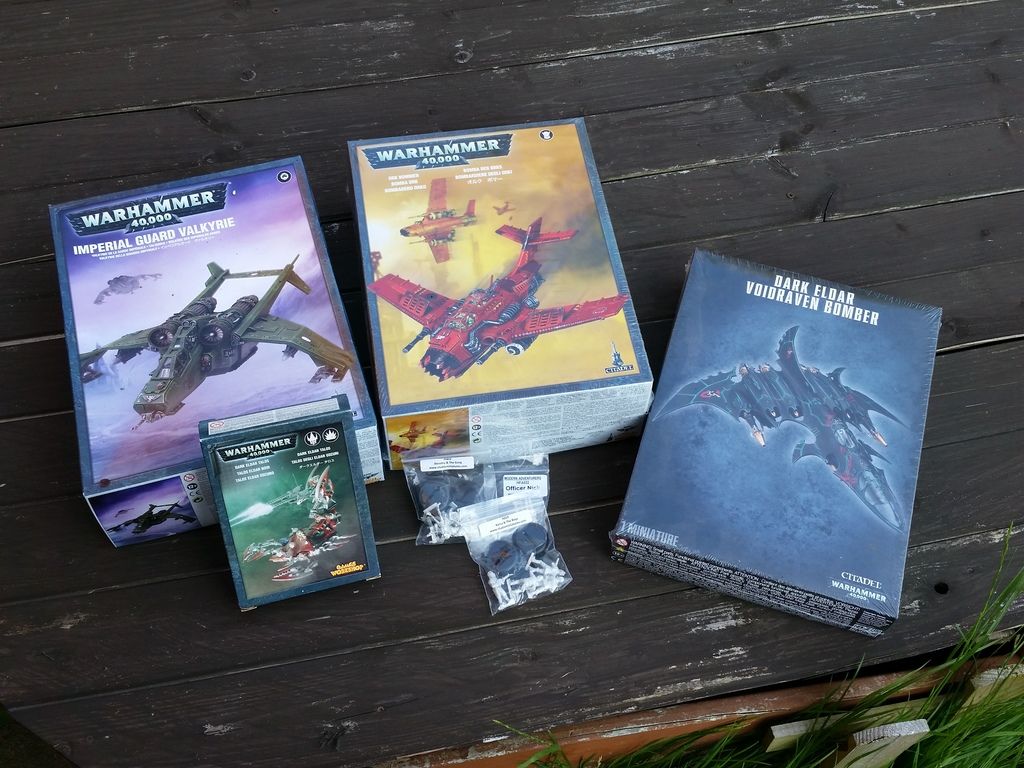
Imperial Guard Valkyrie, Dark Eldar Talos, Ork Fighter Bomber,
Dark Eldar Void Raven and assorted Hasslefree Miniatures
in little bags - and this doesn't include my Age of Sigmar starter set
or beautiful Axe-Faction miniature my beloved wife bought for me!


Alright, since you ask, I'll tell you what happened. Really, two things happened. The first, like many of us I am sure, and a contributing factor to the absence of the Union this year, is that work went crazy. Or should I say 'more crazy', because work for me has been a challenge for about a year now. I guess that's what happens when you are in it at the pointy end, with a hundred emails a day flying at you and nowhere to run.

The other occurrence was that I made a certain 'hobby resolution' at the onset of 2015, which you may or may not recall was to finish off to a 'tabletop' standard two hundred and fifty gaming miniatures by the twelfth chime of Big Ben on December 31st 2015. 

Now then, this painting promise resulted in a flying start to the year, and up to this point I have just upped my total for 2015 to 160 miniatures done and ready to fight. Given that during the whole of 2014 I managed around a third of that number, I think that I have done rather well. The target is twenty per calendar month, and I aim to be averaging twenty five per month come the end of July. I am really aiming for the big Three Hundred by the end of the year if I can.

The unfortunate side effect of all this painting is that it is eating up the vast majority of my hobby time, and as the 'big things' like vehicles are a comparatively minor part of my collection (only about twenty or so tanks), with the vast bulk being made up of various hundreds of infantry and cavalry models, the armour and flyers have found themselves at the bottom of the 'to do' list. Opening stash means 'cutting sprues', filing and scraping components, and assembly, none of which involves a paint brush, and if I plan to hit my targets for the year, the acrylic has to flow like Income Tax out of my wages.

So there we have it. In the previous iteration of this post, I had said that as a gamer first and modeller/painter second, my focus would always be on assembly and game play and painting models would come in its own good time. Having seen just how many unpainted miniatures I own and committed to doing something about it, that focus has shifted considerably. In fact it's a wonder I have time to be typing this post. 

It's a good job really that I don't consider all my unpainted miniatures as stash, because it will take in the region of five years to get it all painted at a rate of 250-300 per year. All I need to do is avoid building up a collection of new models to add to the pile...Doh!!!


For the first time in what feels like an age, thanks for reading. 


P.S. I have signed up to write some gaming based articles for the Creative Twilight blog, and I will link those back to this page, so I invite you to keep a look out for some tabletop delving from me soon.