Howdy wargamers and hobbyists, and welcome to another gaming article guesting over on the Creative Twilight Community Blog. This time around I have presented a rundown of the benefits and detriments of playing multiple miniature wargames rather than focusing my efforts on just one or two, so please hop on over using the link below, and let me have your thoughts.
The Pro's & Con's of being a Multi-gamer
Thanks for reading.

Showing posts with label Painting. Show all posts
Showing posts with label Painting. Show all posts
Monday, 29 August 2016

Wednesday, 10 February 2016
Sky Relics...
Greetings fellow wargamers and space combat enthusiasts. The stars are bright, but the storm is nigh...
Here I bring you another article guesting over on Creative Twilight. A few words about their Painting Contest, which they have used as a great way of engaging with the gaming community, and some photos of the ships I have painted.
Enjoy, and thanks for reading.
Thursday, 27 August 2015
Sprue Cutters Union - Invisible Detail
Greetings Wargamers and Hobbyists, and welcome to the workshop. I am here this time to answer the latest question to be posed to the illustrious members of the Sprue Cutters Union, and it is one that in my opinion pits the desire to achieve the highest level of attention to detail that we are capable of against the practicalities of time constraint and the preservation of our very sanity...

Do you bother with details that will not be seen in the finished product or do you pour your heart and soul into each nook and cranny of the build?
The vast majority of the models I build and paint are gaming miniatures. In practice this means that they are primarily used to fight battles, they are handled and moved around a lot, and they often sit among a group of similar models as part of a larger unit. This also means that most of the miniatures I paint are rarely going to be looked at from less than a couple of feet away, and are even less likely to be turned upside down to see if their nether regions have seen the caress of a brush.
Most gamers are too intent on the game they are trying to avoid losing, rather than the groups of similarly painted miniatures that compose the enemy army to be overly concerned with a really close up inspection of the paint job, and when they are taken with the appearance of a given model, it will tend to be a model which is a focus point of the collection, like a character, a monster or a vehicle. These are what gamers refer to as 'Centrepiece Models'.
Typically only a smaller portion of a gamer's collection is made up of what we call 'centrepiece models', which are often large and impressive kits, and as such draw more attention than the models around them. This therefore tends to mean that they are scrutinised more closely by others. It also tends to mean that, as we know they are a focal point of the army, and this is part of the reason we bought them in the first place, that we are often likely to spend more time on painting them than we would the faceless rank and file of the army.
There are of course those who couldn't do an 'average' paint job on a model if they tried, those who paint every single model in their collection as if it were the last model they would ever paint, the model that they would be judged by forevermore. But we won't talk about those people. For myself, and I imagine for the majority of other gaming hobbyists, the amount of time and effort I put into painting a model, and the degree to which I lavish attention on the bits I know will rarely - if ever - be seen by another person, depends mainly on what the model is and it's role in my collection.
My character models and elite units are going to have much more time spent on them, including the deep recesses of cloaks, the inner folds of clothing and armour, and saddles which will be hidden when the model is assembled, than a model in the centre of the third rank of a horde of Skeleton Warriors, quite simply because with his fellows obscuring the view to him from all angles, and the fact that when not marching to war he spends most of his time stowed in a foam lined carry case, there seems little benefit in spending 'extra' time and attention on areas of the model that never likely be seen.
Equally, the command models of that same block of Skeleton Warriors will get far more brush-time, because not only do they tend to be more impressive than their rank and file brethren, they also carry interesting accoutrements like musical instruments and unit standards rather than just weapons. They are also the last models to be removed when the unit is finally destroyed by the enemy, and they are the models that form the focal point of the front rank. They are the 'face of the unit' if you will, and the rest of the unit are pretty much just filler.
In gaming circles there are a few variations of a phrase: Bases, faces, banners and shields. These are the areas if a model that draw the most attention, and whether it is a centrepiece model or a rank and file nobody, if you get these areas painted to a reasonable standard, then shortcuts elsewhere can go unnoticed. I for example am in the process of trying to paint as many models as I can to a 'battlefield standard' before the end of the year - almost at 180 infantry models, of a target of 250 - and this doesn't mean painting sloppily (not deliberately at any rate), it means painting to a more basic standard that looks fine on the table, but that I can come back to later down the line to spend more time on things like eyes, teeth, general highlighting and other smaller details which just aren't necessary when the goal is to be able to put models on the table for games without cringing.
Part of being able to get through models quickly does however involve cutting corners where I can, and on the unit of 25 Chaos Marauders I am almost finished with for now, this might mean painting a thin layer of brown onto the backs of the shields and leaving them at that, rather than bother with the metal banding and any washes or highlights that are entirely out of sight unless looking at them from behind and beneath. When you look at them from the front, they will look fine, with no obvious bits missed.
Some people take other short cuts with gaming miniatures. If the hatches on a vehicle are going to be closed the whole time, where is the benefit in painting the inside of the passenger compartments? What is the point of painting the underside of a tank or bike if no one will ever see it?
I have heard stories about some armies people have painted to a very strict deadline for a gaming tournament, and tales of weary and bleary eyed gamers painting into the small hours by candlelight the night before an event are common. In these cases it would not surprise me at all to find that corners have been cut wherever possible in an effort to get the entire army to a presentable standard for the event, especially as painting marks are on offer and contribute to the overall winner of the tournament. Though when we hear about gamers who have painted the front of a miniature to an enviable standard, yet have left the back of the model simply base coated because they didn't expect people to see it, you have to wonder when people have bitten off more than they could chew.
For my final thoughts on this topic, I have already described as a gamer which models are going to get more attention and which models less depending on their role in the army, but I think there is also an area of overlap in some cases. When a hobbyist reaches a certain level of ability, and their painting becomes noticeably better than the results of those around them, their collection is probably going to attract an ever increasing volume of attention until, regardless of whether a model is a large centrepiece creature or an inconspicuous infantry model at the back of a reserve unit, every Tom, Dick and Harry is being looked up and down and all over for the quality of his battle attire.
When every model is lavished with a greater than average level of attention to quality and detail, every model is more likely to be scrutinised even more closely than their counterparts in less eye-catching collections, and when that happens, will the painter still feel happy that they can cut the odd corner in order to hit that tournament deadline, or will they have become a victim of their own skill and success, doomed to paint every last shield rear, undergarment and horse's tackle until their eyes fail and their hands shake after decades of painting every boggling detail, just in case someone decides to have a closer look at a model from the back of a unit just to see if the quality of painting is consistent throughout the army?
A nice problem to have some would say.
As always, thanks for reading.
Wednesday, 31 December 2014
Go on then, lets do some Hobby Resolutions!
Greetings fellow wargamers and hobbyists, and welcome to the cusp of a brave new year! It’s that time again, when we say farewell to the year that is ending, slam home a new powerpack, check our sights, and set the time circuits for 2015. Whatever you do…don’t look back.

It seems that year upon year we hobbyists and gamers make the same kind of wishful and occasionally wildly unachievable New Year’s resolutions that everyone else does, though we of course tend to make two sets of resolutions – the mundane kind, like ‘this year I will drink less’, or ‘this year I will lose weight’ – and then, hobby related, resolutions. For us, I think these are the ones that really matter.
While on the subject of hobby resolutions, I have to wonder whether this is something that is unique to Wargamers, or whether it is something that is undertaken across the whole spectrum of hobbyists, from the Scale Model crowd, to the X-Wing mob, the board gamers and even the card gamers? I’d like to find out a little more about this phenomenon.
So, I guess the point of this post (as I am sure it will be for every other hobbyist’s ‘Resolutions post’ you are likely to read), is to tell you all what kind of promise I plan to make for the coming year. Well I decided some months ago what my plan for the coming months (and years) would be, and I guess that this is a chance to make it official.
My New Year’s Hobby Resolution for 2015 is to paint a minimum of 250 models by the end of the year. I am not sure if this seems like a lot or not. It’s certainly enough models to make up one and a half to two armies, so I guess it is quite a few – given that many people make it their task to complete a single army within the current year.
When I break it down to ‘model count per month’, it only comes out at 20, which I think seems much more manageable – 5 each week every week. I plan to continue whenever possible to spend my one hour lunch break at work each day painting, and Thursday evenings for another hour or more while the wife is out at her class, so it’s perfectly achievable in my opinion, apart from the painting time I invariably lose when assembling new models! So the answer is seemingly to not purchase any more models. Or go on holiday – at least not without my painting kit.
In fact, I also need to consider the amount of time it would take to paint single large models as well, which might take 2 weeks on their own. I guess I need to refine my batch painting techniques so that when I am painting infantry models in bulk, I can whizz through them that much quicker. I already bought myself a can of Halfords ‘Rover Russet Brown’ to use to base coat my Bretonnian Peasants and my Orks, after getting on very well with the Halfords matt black primer. Best try a test model first though!
And why 250 for the year? Well, a couple of months ago I had a bit of a tot up of the approximate number of models I have in my Warhammer Fantasy and Warhammer 40,000 collections, and I determined that at a rate of 250 models per year I could have all of my Warhammer and 40K models painted by the time my son turns 8, which is an age at which I think he will be old enough to really start to understand the games to a degree that will allow us to properly start his ‘wargamer training’.
So, there is my hobby resolution for 2015 (and beyond), and my thinking behind it. I really intend push hard on this, and to keep up the momentum both by listening to gaming podcasts while I paint, and to change it up with every new unit I paint between the various armies I have, just to prevent me from getting bored painting all the models from a single army before moving on to the next army. This does however prevent me from taking part in any of the various ‘army painting challenges’ that people are running, because I’m not planning on spending enough time on any one army to complete it in the year – but you never know I guess.
I’d be interested to know what your hobby resolutions are, whatever kind of gaming you are into, so feel free to drop in a comment.
I wish you all a safe and prosperous New Year, full of hobby goodness. See you on the other side, and for the last time in 2014 - thanks for reading.
Wednesday, 21 May 2014
While You Are Out: Sprue Cutters Union #29
Greetings wargamers and hobbyists, and welcome. The Sprue Cutters Union is back!
It's been a while for sure, both since my last post and since the last topic provided by the Sprue Cutters Union high command (Jon over at The Combat Workshop), but now things are all in order and ready to roll. There will however be a change to the SCU posts (Sprue Cutters Union), which is that topics will be issued for consumption monthly rather than weekly.
I am happy enough with this myself, and am very pleased that Jon has been able to accommodate the Spruecutters in among his new schedule. Also, this leaves me with more time to post more gaming related topics and get some more painting and modelling done myself! There will be plenty to talk about, as I have recently picked up the new Dwarf Army Book (get ready for some truly classic models appearing in this very blog), and a new edition of Warhammer 40,000 is right around the corner!
With the introduction out of the way, let's move on to this month's topic:
"How do you keep in the hobby when you are away from the workbench?"
Now Jon has asked the Union to talk about the ways in which we stay connected to the hobby when we aren't actively 'cutting sprue', like research or collecting supplies for or inspiration for our next project. Well in order for me to answer this question, I have had to begin by asking myself "what is my hobby?".
The answer to this question has changed a little over the twenty-plus years that I have been involved in miniature collecting and wargaming, with the advent of things like the Internet, and then eventually the ability to take that wealth of information with us wherever we go.
Where one day in the past the hobby consisted of buying, assembling and painting miniature soldiers, and then using them to take part in 'Little Wars' either at home or at my local gaming store or gaming buddy's homes, it has evolved to also include more writing (campaign material, background fluff, army list generation and of course, this humble blog), and trying to be an active part of what has become a thriving internet and social networking community spanning the globe.
I think that I am fortunate that the various elements of my hobby allow me to talk gaming with hardcore tournament stalwarts, but also discuss the finer points of weathering and composition with modellers and painters that focus exclusively on the visual feast of dioramas and display pieces, and finding interest right across the spectrum.
There is it then. With so many aspects to what consititutes 'my hobby', I am able to keep my hand in when I am away from HQ:
I tend to take a fishing tackle box with me to work, so that at lunchtimes I can sit in the canteen and paint or work on assembly and conversion projects. I find a tackle box has enough room for about a dozen models or so, and twice that number of paints, plus brushes and small modelling tools like files.
In addition to this, I have a 7" tablet (the perfect size for keeping with me pretty much anywhere) which has on it all of my pre-selected complete army rosters and lists of different scenarios and missions for games. It also has on it all my digital rule books and campaign stuff, so that I can work on army lists, campaigns, blog posts and even my novel on this one handy gadget. I always have at least one Codex or Army book in my work bag, and usually a campaign note book too. I used to have an issue of White Dwarf in there as well *grumble, grumble, grumble*
Between the practical hobby goodness carried within my trusty tackle box, and the digital awsomeness that resides on my phone and tablet, I can partake of whatever aspect of the hobby takes my fancy at any given moment, and with internet access via my portable wifi, doubly so. This is why I think that being an all round hobbyist is such a boon.
Some hobbyists only paint and model, so background material, list building and campaigns are of lesser interest. Others only game, in which case they need not only a table, rulebooks, scenery and plenty of time, they also need a whole extra person! No matter where I am, I can take part in my hobby. Even driving in the car I get to listen to wargaming podcasts, so whatever happens I'm covered.
So how do you manage to keep in touch with the hobby when you are away from the workshop?
For anyone who hasn't come across the Sprue Cutters Union (#spruecutters) before, it's what we refer to as a 'blog carnival', which is a series of complimentary blogs which tackle the same topic title from the perspectives of their individual writers.
At the bottom of each SCU post, I will include links to the articles already posted by other Union Members on the topic, and a link to the 'topic hub', which is where members post the links to their articles over at The Combat Workshop - my favourite thing about the Union is getting to read the views of other hobbyists with different interests talking about the same topic - links below!
And finally, if you yourself write any kind of miniature modelling blog, then perhaps you would like to consider joining the Union? All it takes is the dedication to produce one article per month on the topic of the moment, and include links to other members articles at the bottom of your own post as I have done. All you need to do is keep an eye on The Combat Workshop or any of the member blogs for details of the next topic!
As always, thanks for reading.
P.S. I recently felt it in my water that there must be a new Bretonnian Army Book on the horizon, and after being inspired by Wayne Kemp of the Heelan Hammer podcast, I started building my own pair or Trebuchets. Here's the progress:

Sunday, 9 February 2014
We're being tracked...
Greetings wargamers and hobbyists, and welcome to the jungle...ssshh! We're being tracked...

Having been in this hobby for a fair while, but even more so since the advent of the internet, Blog-iverse, Facebook and Twittersphere, if there is one thing that I think gamers, miniature modellers and hobbyists have in common is that we seem to like to track things.
Now I'm not talking about furry quadrupeds in idyllic woodland, I mean projects, gaming, modelling, painting etc. I'm not entirely sure why we do it, but I expect we have an in-built need to organise, catalogue, record and analyse information, it's hard wired into the kind of people we (or most of us) are, and when it's something that plays a significant part in our lives, like our hobby, then it can become something verging on the obsessive.
It seems that not only do we have this need to track hobby related data, we also seem to want to share that information with the world, which can sometimes be a double edged sword. Some people post regularly in a Works in Progress forum thread, others post simple lists of stats in our forum signatures, others still dedicate entire blog posts to it, and a tiny minority talk about it on their podcasts.
So, what kind of hobby related information do we track?
Look to the lists...
I guess the obvious one, but one that people probably don't even realise is a form of tracking, is when gamers keep a roster of their assembled army, and this of course tracks the size of their army as they add models to it (which we need to know in order to be able to agree a size of game to play), and it makes choosing army far easier, because we can take units from our 'standard roster' to form our army to the agreed points total. I keep complete rosters for each of my armies, gangs, fleets, teams etc, so I know both what I have, and the size of game this will allow me to play. Some people like to list each of the armies they collect and their size in points in their forum signatures.
Recruiting and Deployment...
Next, Recruiting and Deployment, which you good people may know better as 'models bought' and 'models painted'. These two things show us and everyone else for that matter, how many models we have added to our collections during the given time period (typically 'this year'), and how many models we have painted. These painted models aren't necessarily the same models as the ones we have bought, but a comparison of the two figures gives us an idea of how well or poorly we are doing in the personal war we fight against bare plastic.
I started recording my own 'bought and painted' stats in my forum signature over on Astronomican at the start of 2012, but that's also the time I decided to trade away and sell all of my old Epic models - a considerable quantity of stuff - which I then used to fund the purchase of a sizeable Ogre Kingdoms army. Quite simply, I traded and sold a lot of models I wasn't using and had little prospect of coming back to finance a load of models that I would use.
Unfortunately, this totally skewed my 'bought vs painted' record, as 'bought' seemed to spiral and painted stayed stagnated, because I was spending my time doing modelling work, assembly work and generally organising the trades and sales and all the incoming miniatures. Well worth it though. I've started again this year. Let's see how I get on...
Role of Honour...
...in other words, 'Games Played'. Some people like to keep a record of the games they have played. Sometimes it's as simple as that he figure, how many games they have played this year, but it can go much further than that. A common record shows how many Wins, Defeats and Draws a player has earned, which can be a fun little stat or a stick to beat ourselves with, depending on how well we are doing and how seriously we take our gaming results.
For my own record, I found it interesting to keep a record which goes back to the point where I joined the MAD Wargames club that I attend regularly. It shows what games system was played, what size of game, what the victory conditions were, who the game was against, the result, and a couple of sentences about the game itself, which typically I use to remind myself where I went wrong. Gamers often say we learn more from our defeats than our victories, and this is where I try to record those nuggets of wisdom. The stats are also interesting because I can break them down by opponent, game system, army and victories vs defeats to see who I play well against, and who I get flattened by, and whether there are some armies I do better or worse with or against.
The thing about game result tracking, is that sometimes our results are being tracked by others as well. In a 40K campaign, or Blood Bowl League for example, it's important to track results in order to asses who is winning and by how much. In fact, games that include 'character development', like Blood Bowl, Necromunda, Mordheim, Warhammer Quest and innumerable other games and RPG's require a detailed level of tracking to be maintained just to enable us to play.
Finally, the most obvious and most talked about form of game result tracking is that which relates to tournaments and competitive events, whether points awarded for painting, or results from games, you can't have a tournament winner - in fact a tournament probably can't progress beyond the opening stages - without tracking the results of the games the participants have played, as the results can determine who a participant plays next, and ultimately who the winner of the event is. These results can then go even further to determine who is eligible to take part in other events, like Masters tournaments and international events, and even who the current top player in a country is, or even just the most successful player in your own garage.
So, if you partake in any of these tracking activities, and someone asks you, 'do you have an analytical mind', you can answer 'yeah, in a manner of speaking...'
If you track gaming related info, why not drop in a comment about it, especially if it's something I haven't mentioned.
Thanks for reading...
P.S. their is no P.S. pic today, because I've been on a bit of a posting spree this weekend, and haven't had a chance to do any hobby, but I have made progress on DIY in the kitchen...watch this space.
Friday, 7 February 2014
Photo Finish: Sprue Cutters Union #27
Greetings wargamers and hobbyists, to another Sprue Cutters Union topic (#spruecutters). Today, we're sitting out on the balcony, reclining on comfortable deck chairs in the glorious sunshine. I would be showing you good people around the lavish photographic studio I use to take stunning pictures of my completed modelling projects, except I don't have one...

This week, the Union Members have been asked to:
- Show us your Photo Studio! -
So that's simple then, straight off the bat; I don't have a set up specifically for taking photos of my models. I do take pictures of my models though, so where do I take them and what with? Let's start with 'where'...
Typically the photos I post for posterity will be taken in one of three possible places: at the canteen table I paint at during my lunch breaks at work, at home in the kitchen, or, as many wargamers do, mid-game, in order to commemorate dramatic moments during battles.
At home and at work, I try and make sure I have two things: a clean and clear background, preferably white, and plenty of light so I can avoid having to use flash. At home, the background is often the white lid of a storage box we have, or the kitchen worktop, which is a wood effect colour, but looks ok for pics. At work, the canteen tables are fairly large and a very pale off-white, so I can take pics with just the tabletop in the background.

At home and at work, I try and make sure I have two things: a clean and clear background, preferably white, and plenty of light so I can avoid having to use flash. At home, the background is often the white lid of a storage box we have, or the kitchen worktop, which is a wood effect colour, but looks ok for pics. At work, the canteen tables are fairly large and a very pale off-white, so I can take pics with just the tabletop in the background.
What I want from the background is to allow me to take pictures that keep the miniatures as the highlight. I don't want the background to detract from the miniatures or impact the colours I have used in my paint scheme. It's far better if I can avoid using the flash, because natural light gives a better, more natural image and shows the paint colours more like they appear first hand. I'll settle for artificial lighting, but flash is a last resort. I guess that because I don't have a dedicated space for photography, I'll take what I can get. I have in the past used a roll of white paper to give a background, and even layed out white or grey card to place models on.
Secondly, 'what with?' I used to use a Lumix TZ6 compact camera on the macro setting. As it's a ten megapixel camera (I think), I can get good results with it, but it's a bit of a pain having to take the camera to work or to games, even though it's a compact. It's one more thing that can get lost, stolen, left behind or dropped. More recently, for about the last eighteen months in fact, I have just used the camera on my phone, which is five megapixels (again, I 'think'), and a macro setting. This seems to do just fine as long as the background and lighting is all ok. It also allows some interesting effects to be applied for 'in game' shots. With pics to show what the painting looks like, I go without the special effects.
At the moment, I'm not taking pictures with enough seriousness to need anything better than I have, but I would like to think about something a little more permanent if possible and if space allows...
If you would like to read more posts on this topic, especially from scale modellers with much better set-ups than mine, I invite you to check out the links to member blogs below, and also to the Topic Hub over on The Combat Workshop, where members will post links to their excellent blogs as they release them.
Finally, if you would like join the Union yourself, then check out the details here. All you need is your own blog, and a passion for miniature modelling.
Topic Hub
BW
Doog's Models
The Garage Gamers
Finally, if you would like join the Union yourself, then check out the details here. All you need is your own blog, and a passion for miniature modelling.
Topic Hub
BW
Doog's Models
The Garage Gamers
Thanks for reading...
P.S. Here are the models I am about to start painting, a gift from my wife for my Birthday, produced by Hasslefree Miniatures...as soon as I can get them spray undercoated that is.

Friday, 8 November 2013
Preparing for War...
Greetings wargamers and hobbyists. Following up from my earlier post as part of the Sprue Cutters Union initiative for this week, all about the brushes we use, here are a couple of photos of the Dark Angels Tactical Squad I have been working on.
They're now battle ready, so I won't be doing any more work on these guys until the rest of the 4th Company has been painted up to the same stage. Guys, meet Tactical Squad Scivius, 3rd Squad, Dark Angels 4th Company...


Brush Up: Sprue Cutters Union #16
Welcome wargamers and hobbyists, to the art room. This room may look a little dishevelled, uncoordinated, littered with random objects and fresh out of the 1970's, but it's modelled precisely on the room where I used to take my art lessons when I was at school. And before anyone comments, the room was old when I was at school in the 90's. I was not at school in the 70's...
- What is your preferred airbrush/paint brush manufacturer? -
Ok everyone, this week the Sprue Cutters Union has been asked the very simple question above, which for me is especially simple to answer, as I don't own and have never utilised an airbrush...
The reason for this is simple: the wargaming miniatures I paint are generally too small to benefit from the use of an airbrush, apart from vehicles, but I don't have enough vehicles in my generally infantry heavy collection to warrant the purchasing of an airbrush either. One day I might consider one, if I think it would see use, but not at the moment.
This leaves the good old dependable paint brush.
In the begining, there was Citadel. This is the 'paints and brushes' arm of Games Workshop, who's models I collect and who's paints I generally use on my projects. Citadel paints, citadel brushes etc etc etc. I have always found the quality of Citadel products to be pretty good, but like anything, paint brushes wear over time. The tips become less sharp, they lose the odd bristle through copious use, they generally start to look a bit like they have seen battles from the sharp end rather than just the prep end.
When it came to replacing my citadel brushes recently, I decided to have a look around, in shops and online. I wasn't really looking for a particular manufacturer, just a good quality brush that wouldn't lose bristles like I lose Warhammer games, and was cheaper than the now significantly inflated cost of the Citadel brushes. As it turned out, the Citadel brushes were not all that costly for their quality, and many other brushes were at least as expensive. I wasn't in a crazy rush, but the brushes I was trying to eek a little more life out of were getting on my nerves, so I kept looking, every time we went into a shop that sold any kind of art supplies, at the brushes they had and the prices.
Eventually, my wife and I were actually in the local cake and crafts shop in our village, a great little place with some interesting bits and pieces, and talented owner who runs workshops and bakes cakes to order which have some incredible decoration iced onto them. I swear that woman could make any cake I wanted. In fact, I wonder whether I should make a special request for my birthday cake. A Tyranid spore mine maybe...
Anyway, back on topic, the craft shop sells cake decorating brushes, which I guess are intended for painting icing with patterns or colour or whatever, and they came from about size 1 to size 4. I got chatting to the owner and her scale model building husband about the brushes, and it turned out they could order whatever sizes I wanted. After having a good look at the brushes, and finding out that they had been selected by the owner's husband (who knows a thing or two about painting miniatures) ordered a couple of size 1's, a couple of 0's, a couple of 00's and two 000's right there and then.
After I picked up the brushes, I was cautiously pleased with them. They were pure sable, smart brushes, but had only cost me a measly £1 each! For that kind of money I expected to get something that looked nice in the beginning but would quickly wear and fall to pieces. Not so. A few months down the line, the brushes are still good and have kept their tips (most important when adding fine highlights and small details), and I can't see me needing to find another brush supplier anytime soon. Not at that price.
As for the manufacturer, the size 1's were marked as 'Windsor Cake Craft', but whether this is one of the brushes produced by the well known Windsor brand I don't know. The rest are marked as AES, who I have never heard of, so if anyone else has had experience of brushes by AES, I would be interested to find out how you fair with them.
If you would like to read more posts on this topic, especially those written by scale modellers who will extoll the virtues of various brands of air brush, I invite you to check out the links below to their most excellent blogs.
Yet Another Scale Modeller
Migrant's Wanderings
Kermit's Bench
Lt Smash's Models
Fill n' Sand
And of course, The Combat Workshop
Migrant's Wanderings
Kermit's Bench
Lt Smash's Models
Fill n' Sand
And of course, The Combat Workshop
Also, for anyone who thinks they might like to join the Sprue Cutters Union (#spruecutters), look here for details on how to join. All you need is a blog, and a passion for miniature modelling. We would love to have you aboard.
As always, thanks for reading...

Wednesday, 6 November 2013
Quickie Basing
Ok Wargamers and Hobbyists, here is a quick step by step showing you how I do the basing on my gaming minatures. I find that this method is quick, and works just as well for big gribbly monsters and smaller individual troopers. It also works fine for both my Fantasy models and my 40K models. This is gonna be real quick...
The base on this Dark Angels Marine (First Legion for the win!) has had a layer of sand glued to it using PVA glue - just plain old sand, though it looks better if you mix a hand full of gravel into your sand container to give some texture variety. After the glue has dried, the base has then been painted with a dark brown. I used to use Games Workshop's 'Scorched Brown' until I realised how much of it I was using for basing, now I use a cheapo dark brown emulsion from Wilkinsons called 'Java Bean'.


The base on this Dark Angels Marine (First Legion for the win!) has had a layer of sand glued to it using PVA glue - just plain old sand, though it looks better if you mix a hand full of gravel into your sand container to give some texture variety. After the glue has dried, the base has then been painted with a dark brown. I used to use Games Workshop's 'Scorched Brown' until I realised how much of it I was using for basing, now I use a cheapo dark brown emulsion from Wilkinsons called 'Java Bean'.

After the brown has had plenty of time to dry, the base of the model below has been given what I call a 'heavy drybrush' of GW's Vomit Brown, which is just a pale brown that has a touch of yellow or orange to it.

Next, the base has been given a more measured drybrush with a pale bone colour - in this case, GW's Bleached Bone. This adds a third colour to the base, and picks out all the little stones and bits and pieces, giving it some depth and texture.

Finally, when enough men have died...hang on, that's not right. Finally, I apply a scattering of static grass, This is the short stuff, which has a mixture of grass colours in it to stop it looking like a flat artificial colour.

Really, that's it. A couple of people have commented on my basing, and rather than let people think it was in any way difficult, I thought I'd just post up a quick guide to how it's done. Nothing spectacular, but it's quick and easy and looks alright, whether it's a model with a big base or a small base, and whether there is just a single mini or an army. With Warhammer Fantasy regiments, where the models are all lined up in ranks so you can't see the base edges so much, it works even better. I have often thought that just a little bit of extra work on the bases can make a world of difference, and make a model really look finished. That's it.
Thanks for reading.
Wednesday, 18 September 2013
Paint: Sprue Cutters Union #9
Greetings wargamers and hobbyists, and welcome once more. Today, we are in my 'technicolour dream chamber'. This is where all my model paints come to hang out, chill, and take in the wondrous kaleidoscope of colours.
This week's Sprue Cutters Union topic is:
- What paint(s) do you use? -
As Jon said when he posted this topic, it's more of a practical discussion point than some recent topics covered, which were very interesting and gave us a peak into the minds of Union Members, but were also quite subjective and philosophical.
My answer to this topic will probably be quite different from that of most of my fellow union members, who in the main are scale model builders, but might share commonality with posts by the minature wargamers among them.
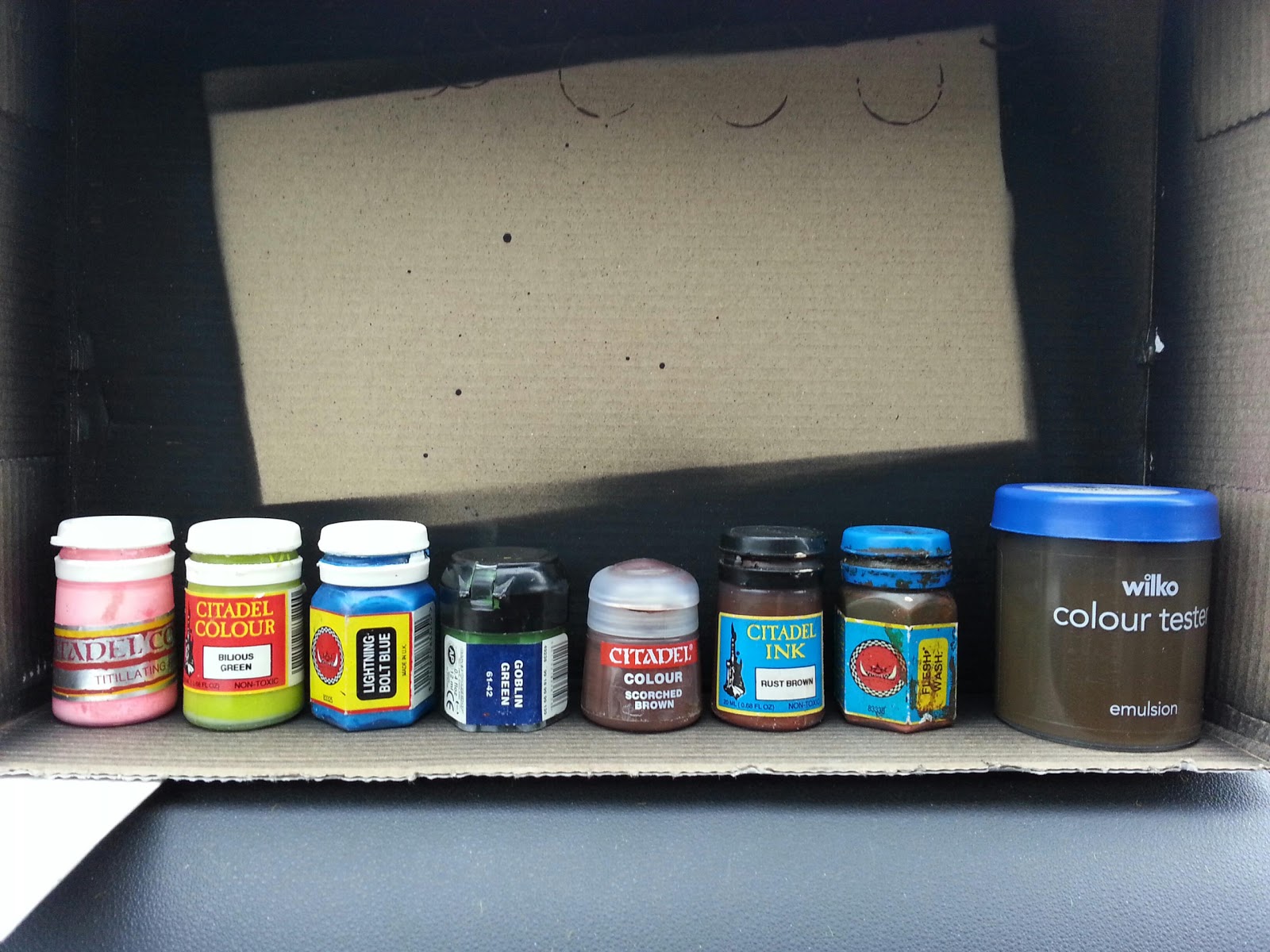
What paints do I use? Simple really: I use Citadel miniature paints, which I believe are a non-toxic acrylic. These are the paints produced by Games Workshop for use in painting the models that they produce, and I have always found tham to be a really great quality product. I also use their range of inks and washes, for shading and glazing on my wargaming miniatures. I have been collecting for many years, and as I am typically a sporadic painter, I tend to go through my paints quite slowly as well. This has resulted in my collection of paints incorporating multiple generations of colours and pot shapes, all by Games Workshop (pictured below, oldest to newest going left to right, plus ink, wash, and terrain/basing paint), the names and shapes some of which have passed into legend...
Now, there is an important consideration with miniature painting that comes before applying base coats, washes and highlights with a brush, and that is undercoating. I don't know whether undercoating is wholly necessary with scale model building, but if you want a clean and clear finish on your paint coats, and want the paint to stay on the model, then with gaming miniature painting you should always undercoat your models.
The undisputed king of undercoating must be the ubiquitous spray can, and for many years I have used Citadel's own Chaos Black and Skull White sprays, though with the cost of this excellent spray steadily increasing, I recently decided to try out Halfords Matt Black spray, which so far seems to work just fine, is cheaper per can, and the can is 25% bigger than either the Citadel or Army Painter (another brand which seems popular at the moment) cans.
As yet, I haven't decided to try out any other colours which might make a good base coat and save me a lot of time hand painting the predominant colour on any given set of models, but I think it must be on the cards after my success with the black.
So, thus far we have covered the colour pots of paint, the inks and washes, and the undercoat. So, given the size of the miniatures I typically paint, what on earth is that large pot of brown paint on the far right of my picture below? Well, when I recently got right back into painting properly, I realised that one aspect of finishing I had never addressed with a serious desire to get a good result was basing. I quickly realised that a well finished base really lifts a model, unit or terrain piece. I then went on to perfect (I use the term loosely) a method of basing that I am happy with and is quick to do:
Glue sand and rocks to the base. Citadel's Scorched Brown for base coat, Vomit Brown liberal heavy drybrush over the Scorched Brown, and then a light drybrush of Bleached Bone to highlight. Finish by sticking on a couple of clumps of static grass.
This method of basing resulted in two things. First, my finished models really did look finished, and second, I went through Scorched Brown paint like a Goblin Fanatic goes through magic mushrooms. Hence the £1 tester pot of Wilkinsons 'Java Bean' emulsion. It's almost an exact match for Citadel's Scorched Brown, is about half the price for a pot, and as for the quantity in the pot itself...the currently available pot of Scorched Brown is the tiny one next to the tester pot...
So, that's my rundown of paint that I use for my wargaming miniatures. If you would like to read more posts on this topic by other Sprue Cutters Union Members, check out this link, which will give access to other posts as they are added. It looks like my post is first this week!
And finally, if you fancy yourself as a Sprue Cutter, all you need is a blog, and a passion for miniature modelling. Take a look here for more info.
Thanks for reading!
Tuesday, 21 May 2013
Painting Survivor Series!
Greetings fellow wargamers, and welcome once more to my humble hearth. This time around, I have been inspired to talk about an invention of mine...
I like to think that I am an all round hobbyist, by which I mean that I play games, assemble and convert models (with even a little 'greenstuffing' thrown in from time to time), I write fluff, I collect, and I paint models. Now, not everyone likes every aspect of the hobby to the same degree. I will happily admit that I prefer gaming to almost everything else, and though I like seeing painted armies on the table top, and do paint from time to time, I haven't been concerned about the painting aspect sufficiently to push me to paint the hordes of models I have built up over the years.
I am sure that I am not the only gamer in this position: lots of models, but lacking the drive and motivation to get them painted. Sometimes I get into a painting mood and spend a few sessions knocking out a few models here and there, but I start to flag before I make much of a dent in my 'to do' list.
This is why I came up with the idea of the Painting Survivor Series. It's really just a bit of fun, a motivational tool intended to give inconsistent painters like myself a small incentive to start a painting project and keep going, rather than downing brushes a week later.
The premise is simple enough: an 'iron man' style endurance painting competition which is posted as a communal 'Work In Progress' thread on your forum of choice. In my case this is the Astro Wargaming Community forum. The basic rules are that each participant is required to post photos of the project they are working on every third day after the Opening Day, in order to display their painting progress, bearing in mind that the key phrase is 'Noticeable Progress'.
Progress includes everything from undercoat to completion of basing, which though not strictly all painting (static grass etc), allows people to get that last bit finished off before moving on to the next project. Any participant unable to post pictures of their progress for ANY reason is eliminated. This includes not having time to paint due to work or family commitments, batteries in the camera running out, or internet access problems.
To be a Survivor, you have to paint and you have to post, come rain or shine. If a participant was the 'last painter standing', then they are rewarded by being able to proudly display a badge in their forum signature declaring that they are a Painting Survivor. A fair amount of barracking and verbal 'one-upmanship' went on I can tell you.
Originally, the plan was to keep going until we had just one Survivor remaining, but within a couple of Series, this was resulting in 'paint-offs' that wouldn't end, the last two or three painters gritting their teeth and preparing to sell their soul rather than be eliminated.
I decided that, in order to be able to end a Series in a reasonable time, and give participants a 'light at the end of the tunnel' to aim for, (not to mention letting eager participants that had been eliminated have another bite of the cherry) I would limit the number of posts that would have to be made before reaching the end of the Series to twenty. That's twenty posting days met without being eliminated, which is about two month’s worth of painting work. Anyone who made it to the end would still get a Survivors badge to add to their signature, but if we did have a 'last man standing' situation before the end of the Series, then a purity seal could be added to the badge to display the winner's painting prowess.
In time, as people took part in successive Series, we decided to add to the existing badge rather than have more than one, so we added a tiny skull with a number on it’s forehead corresponding to the series that the participant took part in. The badges are awesome, and were created by a kind forum member, so a shout out goes to LutherMax, thanks for that bud, the icing on the cake for sure.

After six successful series, and about to start a seventh (after a lengthy pause it must be said), I have found that I have got more painting done as part of the Astro Painting Survivor Series than at any other time in recent years, and I am sure that others have felt the same benefit. It's amazing how much motivation you can draw from being part of a communal project, to see what multiple other painters are doing and how they are getting on all in one place, rather than as part of a single isolated thread. Why not mosey on over to Astro and have a look at past threads?
So, if you find that you struggle to maintain a fair pace when it comes to painting your miniatures, or that you are easily distracted by other things like the new series of Doctor Who, why not set up your own Painting Survivor Series, rope in those forum or club members who want to get their armies painted and on the table but don't seem to be able to build up enough steam to get it done, and see who has the stones to be the Last Painter Standing...
Thanks for reading.
I like to think that I am an all round hobbyist, by which I mean that I play games, assemble and convert models (with even a little 'greenstuffing' thrown in from time to time), I write fluff, I collect, and I paint models. Now, not everyone likes every aspect of the hobby to the same degree. I will happily admit that I prefer gaming to almost everything else, and though I like seeing painted armies on the table top, and do paint from time to time, I haven't been concerned about the painting aspect sufficiently to push me to paint the hordes of models I have built up over the years.
I am sure that I am not the only gamer in this position: lots of models, but lacking the drive and motivation to get them painted. Sometimes I get into a painting mood and spend a few sessions knocking out a few models here and there, but I start to flag before I make much of a dent in my 'to do' list.
This is why I came up with the idea of the Painting Survivor Series. It's really just a bit of fun, a motivational tool intended to give inconsistent painters like myself a small incentive to start a painting project and keep going, rather than downing brushes a week later.
The premise is simple enough: an 'iron man' style endurance painting competition which is posted as a communal 'Work In Progress' thread on your forum of choice. In my case this is the Astro Wargaming Community forum. The basic rules are that each participant is required to post photos of the project they are working on every third day after the Opening Day, in order to display their painting progress, bearing in mind that the key phrase is 'Noticeable Progress'.
Progress includes everything from undercoat to completion of basing, which though not strictly all painting (static grass etc), allows people to get that last bit finished off before moving on to the next project. Any participant unable to post pictures of their progress for ANY reason is eliminated. This includes not having time to paint due to work or family commitments, batteries in the camera running out, or internet access problems.
To be a Survivor, you have to paint and you have to post, come rain or shine. If a participant was the 'last painter standing', then they are rewarded by being able to proudly display a badge in their forum signature declaring that they are a Painting Survivor. A fair amount of barracking and verbal 'one-upmanship' went on I can tell you.
Originally, the plan was to keep going until we had just one Survivor remaining, but within a couple of Series, this was resulting in 'paint-offs' that wouldn't end, the last two or three painters gritting their teeth and preparing to sell their soul rather than be eliminated.
I decided that, in order to be able to end a Series in a reasonable time, and give participants a 'light at the end of the tunnel' to aim for, (not to mention letting eager participants that had been eliminated have another bite of the cherry) I would limit the number of posts that would have to be made before reaching the end of the Series to twenty. That's twenty posting days met without being eliminated, which is about two month’s worth of painting work. Anyone who made it to the end would still get a Survivors badge to add to their signature, but if we did have a 'last man standing' situation before the end of the Series, then a purity seal could be added to the badge to display the winner's painting prowess.
In time, as people took part in successive Series, we decided to add to the existing badge rather than have more than one, so we added a tiny skull with a number on it’s forehead corresponding to the series that the participant took part in. The badges are awesome, and were created by a kind forum member, so a shout out goes to LutherMax, thanks for that bud, the icing on the cake for sure.
After six successful series, and about to start a seventh (after a lengthy pause it must be said), I have found that I have got more painting done as part of the Astro Painting Survivor Series than at any other time in recent years, and I am sure that others have felt the same benefit. It's amazing how much motivation you can draw from being part of a communal project, to see what multiple other painters are doing and how they are getting on all in one place, rather than as part of a single isolated thread. Why not mosey on over to Astro and have a look at past threads?
So, if you find that you struggle to maintain a fair pace when it comes to painting your miniatures, or that you are easily distracted by other things like the new series of Doctor Who, why not set up your own Painting Survivor Series, rope in those forum or club members who want to get their armies painted and on the table but don't seem to be able to build up enough steam to get it done, and see who has the stones to be the Last Painter Standing...
Thanks for reading.
Subscribe to:
Posts (Atom)